


AstroJung
Free birth chart with plain-language explanations: your archetype, where your shadow holds on, dreams and relationship charts. A mirror, not a forecast.
- Launched
- Clicks
- 47
- Runs on
- Web, Android, iOS
- Pricing
- Free plan, paid upgrade
About AstroJung
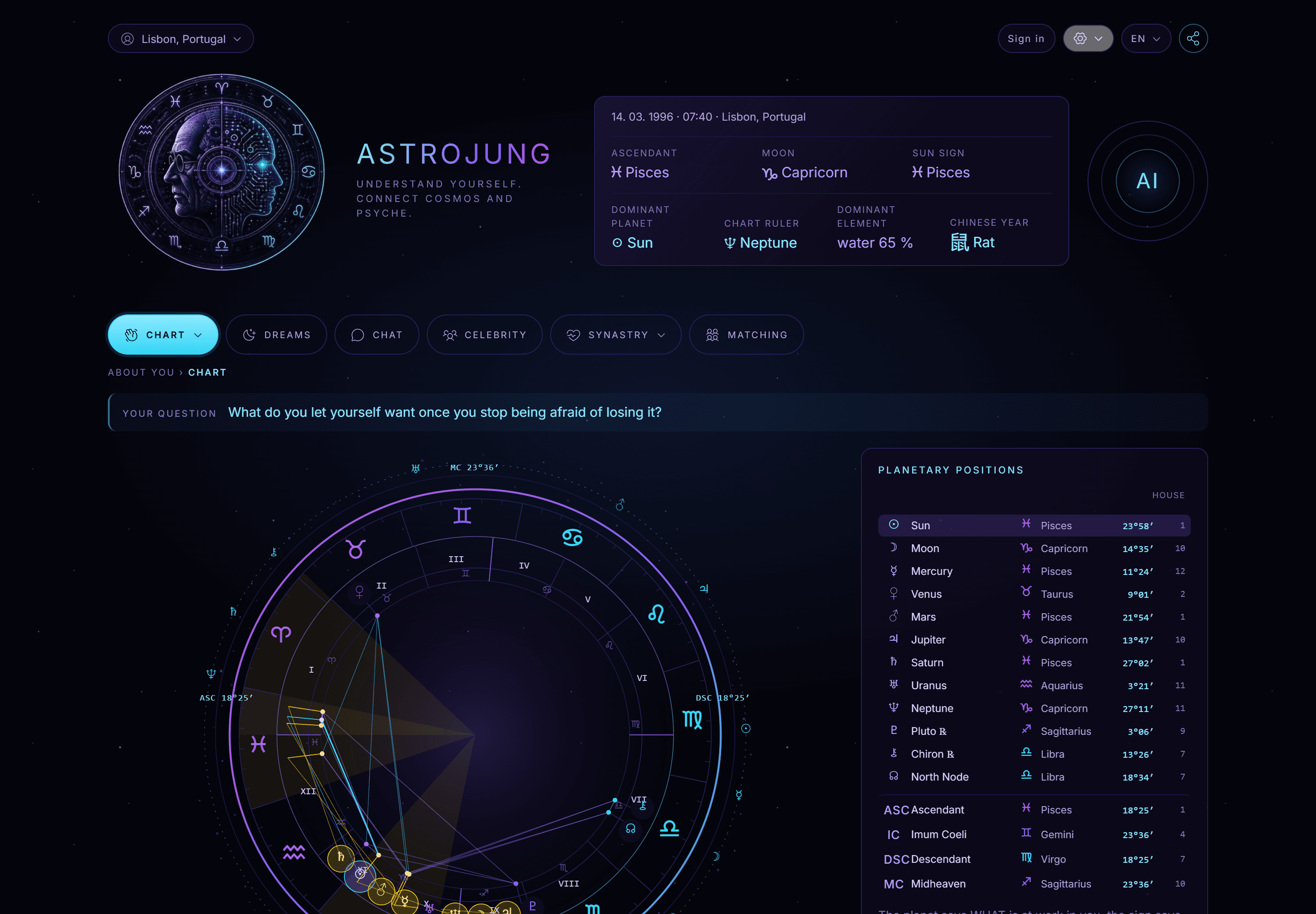
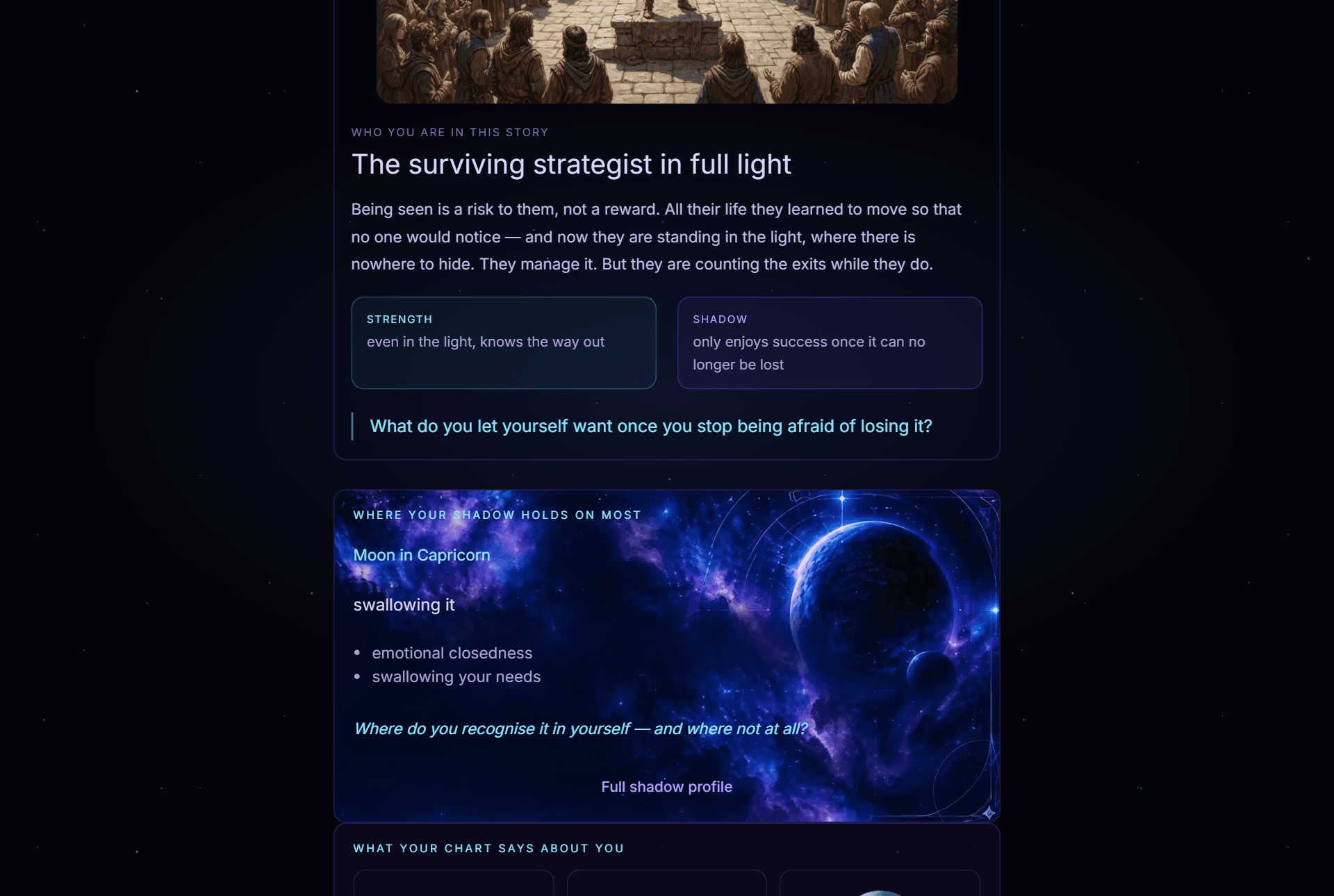
AstroJung reads a birth chart through the psychology of C. G. Jung: the archetype you live, where your shadow holds on most, what your dreams keep repeating, and how two charts meet.
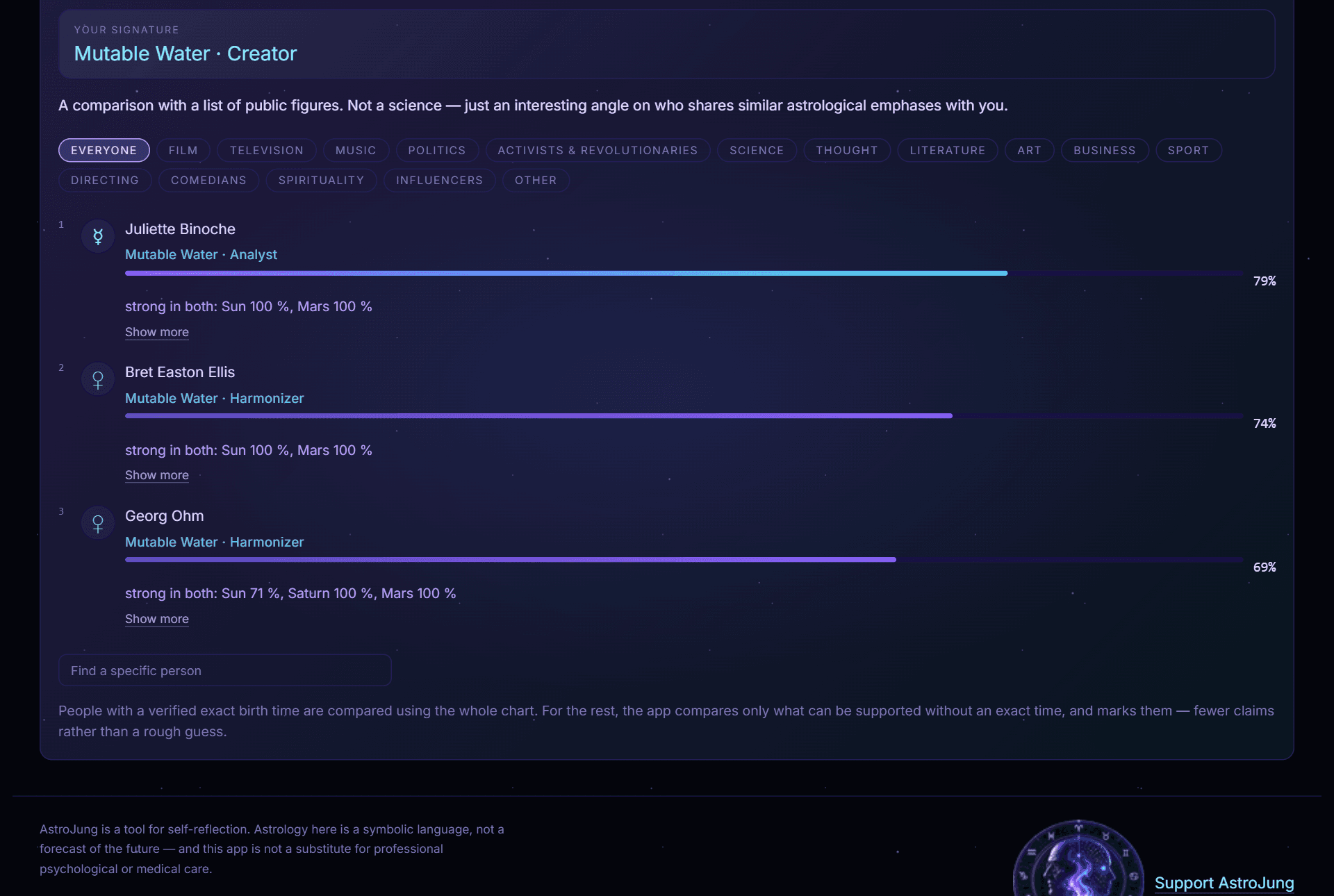
Free, without an account: the birth chart with plain-language explanations, your archetype and shadow, and a comparison with public figures whose charts share similar emphases.
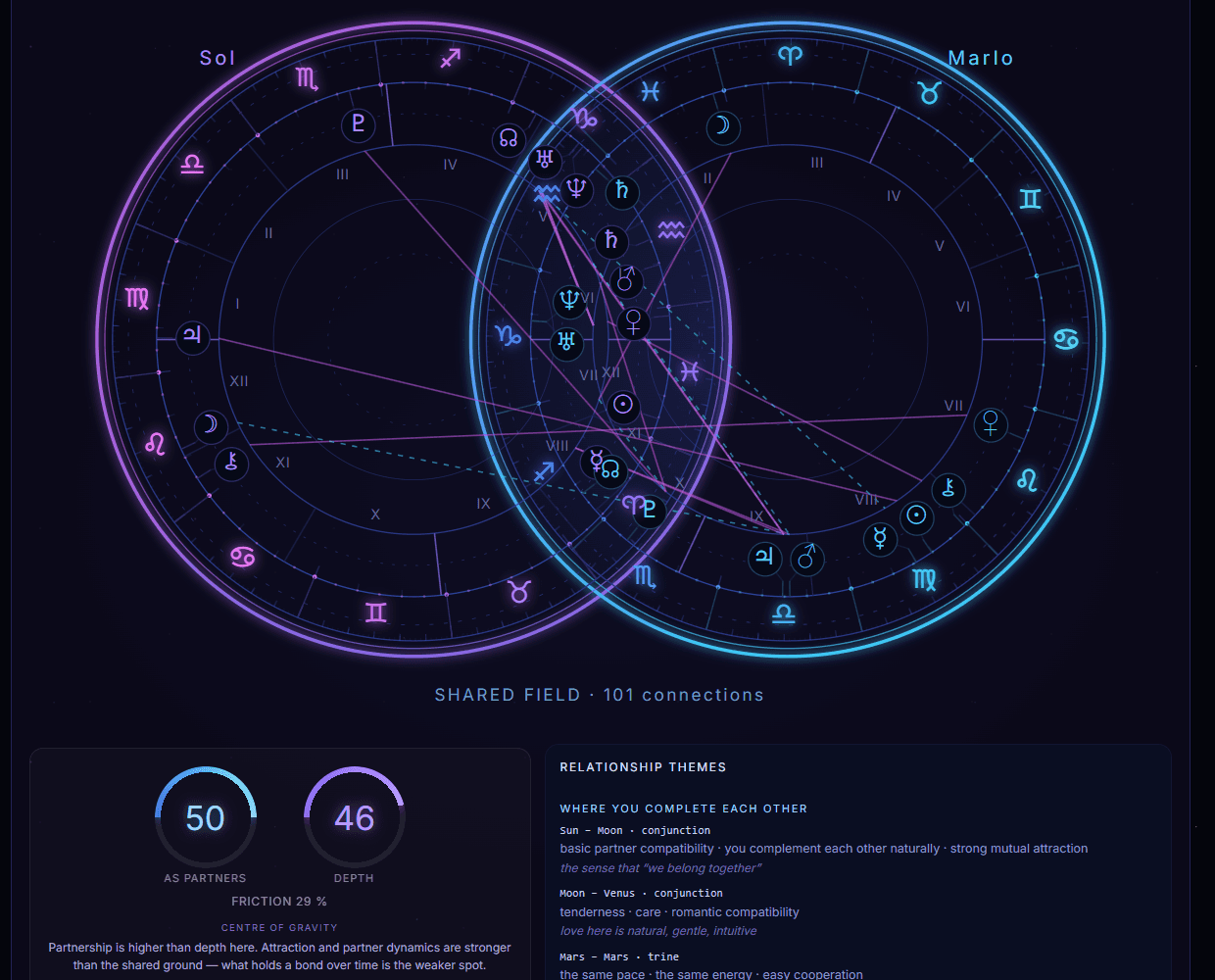
With a free account: deeper readings, a journal whose questions come from your chart, relationship charts (synastry and composite) and dream work. A dream you write down is read symbol by symbol, and the app looks for the images that keep coming back.
What it does not do: it never predicts the future. When the exact birth time is unknown, it leaves the houses and the Ascendant out instead of guessing. It is a tool for self-reflection, not a substitute for professional psychological or medical care.
Optional Pro plan for more readings. Eight languages: English, Spanish, German, French, Portuguese, Polish, Czech and Slovak.
What AstroJung does that nothing else does
It reads the chart through Jung and never predicts: every reading ends with a question, not a forecast.
Who AstroJung is for
People curious about their birth chart who want self-reflection rather than horoscopes, and anyone who writes down dreams or keeps a journal.
Written up on SpacerrApps
Apps like AstroJung

TAROTAI.CHATTAROTAI.CHAT0 clicks
TAROTAI.CHAT offers writers and creative thinkers an archetypal springboard through multi-style 78-card Rider-Waite spreads and AI dialogue.
AI, Lifestyle, Media

EroLove0 clicks
AI sex chat with characters we wrote ourselves, like Rae, who works nights behind a bar in Leeds. Walk into a scene that's already going.
AI, Social, Lifestyle

Clean Paste AI0 clicks
Clean Paste AI removes invisible Unicode artifacts and Markdown syntax from AI copy so spreadsheet cells and tables remain properly formatted.
Productivity, AI, Writing

AI Text Watermark Remover0 clicks
Content managers choose AI Text Watermark Remover to spot 60+ invisible Unicode code points and clear excess Markdown residue.
Writing, Productivity, AI

FloHub0 clicks
One calm place for your whole day — and a cat who actually gets it. Tasks, calendar, habits, notes and journal, guided by FloCat.
Productivity, AI, Mobile

10 comments
Marco Bellini
How does AstroJung choose the public figures whose charts are shown as similar to mine?
AstroJungMaker
The app compares your chart with a list of about 3,600 public figures whose birth data has a documented source.
For each person it scores what the two charts share: • which planets are strongest in both charts (this counts the most) • the signs of the Sun, Moon, Mars and Ascendant, including a shared element or modality when the sign itself differs • how much of both charts falls into the same signs • the Chinese zodiac sign, as a small extra
The percentage shows how much of that matches. Under each name you can see the reasons, so it's clear why that person came up.
Where a birth time isn't documented, only the Sun, Moon, Mars and Chinese year are compared, and the name is marked "time unverified". You can also filter by field (film, music, science, sport…) or search for a specific person.
It's meant as an interesting angle on your chart, and the app says so plainly: it isn't a science.
Nora Callahan
What extra readings and tools are included in AstroJung’s optional Pro plan?
AstroJungMaker
Pro doesn't add a separate set of readings so much as take the limits off the ones you can already try for free. Without an account, you get your full chart with every placement explained, and the comparison with public figures. With a free account, you can try almost everything: the psychological portrait, the shadow profile, dream readings, today's sky, the chat with the guide, relationship readings and matching. Pro (€9 a month or €90 a year, cancel anytime) removes the caps: • the full psychological portrait and the conversation with the guide, with no limit • the shadow profile and the shadow of the Moon, including the exact dates and strongest days of a shadow window • a dream reading for every dream you write • the journal, with a question for every day • unlimited saved charts (six are free) The idea is that you can find out whether it's useful to you before paying anything.
Tomas Keller
If I do not know my exact birth time, which parts of my birth chart can AstroJung still read?
AstroJungMaker
Good question, Tomas — this comes up a lot.Without a birth time, AstroJung still reads the planets themselves — Sun, Moon, Mercury, Venus, Mars, Jupiter, Saturn, Uranus, Neptune, Pluto — each in its sign. That's enough for the archetype and shadow readings, since those come from sign placements, not houses. The one planet with any uncertainty is the Moon: it changes sign every couple of days, so on rare dates it could have shifted mid-day.
What it leaves out: the Ascendant, the Midheaven, the houses, and anything built on them, like the dominance overview. Those all depend on the exact minute, and the app would rather say nothing than guess. If you find your birth time later, that layer opens up.
Short version: your planets in sign, yes. Houses and Ascendant, only with a real time.
Lena Horvat
What is the difference between a synastry chart and a composite chart in AstroJung?
AstroJungMaker
They answer two different questions, Lena.
Synastry puts your two charts side by side and looks at how they touch: where one person's Venus lands on the other's Moon, where one of you presses on the other. In AstroJung it's split into six readings: attraction, emotional language, how you argue and hear each other, who you see in the other person (projection, the most Jungian part), karmic or just strong, and what the relationship can carry.
The composite is a single new chart, calculated from the midpoints between your two charts. It doesn't describe either of you. It describes the relationship itself as a third psyche: what it's about, how it feels from inside, what holds you together and where the tension lives. It's not a verdict on whether it will last, and it can be read even after a relationship has ended.
In short: synastry is you and them. The composite is the "we".
Marta Vidal
How does AstroJung handle dream symbols that do not fit its usual interpretations?
AstroJungMaker
Thank you, Marta — that's exactly the question Jung cared about most. For him a symbol never had one fixed meaning; it belonged to the person who dreamed it.
So AstroJung doesn't work from a dictionary. It reads the dream symbol by symbol against your own birth chart and what is active in it right now, so the same snake or house can mean something different for two people. It also keeps track of the images that come back across your dreams, because a symbol that repeats says more than any single interpretation.
And when a reading misses, you can say so. If you write "the house wasn't mine" or add what happened next, the app takes your word as a fact about the dream and reads the whole dream again. You dreamed it, the app didn't.